How Many Countries in Europe? Full List of 45
Discover all 45 European countries organized by region and in alphabetical order, with their capitals, flags and populations. Interactive quiz included!
How many countries are in Europe?
Europe has 45 sovereign countries recognized by the United Nations, spread across 10.18 million km² with approximately 744 million people — roughly 9% of the world's population.
From the Arctic Circle to the Mediterranean shores, from Atlantic cliffs to the Ural steppes, Europe offers remarkable cultural and linguistic diversity on a relatively compact territory. Over 200 languages are spoken across the continent, which is home to the European Union (27 members) and some of the oldest civilizations in history.
Ready to test your knowledge? After exploring this list, try our Listing quiz to name all European countries or our European flag quiz!
Alphabetical list of the 45 countries in Europe
If you want the quickest possible answer, here is the full list of European countries covered in this guide. We follow the scope of the 45 sovereign states recognized by the United Nations: Vatican City, a permanent observer state, is therefore not included in this total even though it is often mentioned in geographic comparisons.
Albania, Andorra, Austria, Belarus, Belgium, Bosnia and Herzegovina, Bulgaria, Croatia, Cyprus, Czechia, Denmark, Estonia, Finland, France, Germany, Greece, Hungary, Iceland, Ireland, Italy, Latvia, Liechtenstein, Lithuania, Luxembourg, Malta, Moldova, Monaco, Montenegro, Netherlands, North Macedonia, Norway, Poland, Portugal, Romania, Russia, San Marino, Serbia, Slovakia, Slovenia, Spain, Sweden, Switzerland, Turkey, Ukraine and the United Kingdom.
For a more visual overview, you can also explore our Europe regional page and the full directory of world countries.
What are the countries of Northern Europe?
Northern Europe has 10 countries. From Norwegian fjords to Baltic plains, this region stands out for its spectacular landscapes, some of the highest living standards in the world and long-standing democratic traditions. The Nordic countries (Sweden, Norway, Finland, Denmark, Iceland) form a particularly close cultural and political group.
| Flag | Country | Capital | Population | Area |
|---|---|---|---|---|
| 🇸🇪 | Sweden | Stockholm | 10,605,098 | 450,295 km2 |
| 🇳🇴 | Norway | Oslo | 5,606,944 | 386,224 km2 |
| 🇫🇮 | Finland | Helsinki | 5,650,325 | 338,455 km2 |
| 🇬🇧 | United Kingdom | London | 69,281,437 | 244,376 km2 |
| 🇮🇸 | Iceland | Reykjavik | 391,810 | 103,000 km2 |
| 🇮🇪 | Ireland | Dublin | 5,458,600 | 70,273 km2 |
| 🇱🇹 | Lithuania | Vilnius | 2,894,886 | 65,300 km2 |
| 🇱🇻 | Latvia | Riga | 1,829,000 | 64,559 km2 |
| 🇪🇪 | Estonia | Tallinn | 1,369,995 | 45,227 km2 |
| 🇩🇰 | Denmark | Copenhagen | 6,011,488 | 43,094 km2 |
What are the countries of Western Europe?
Western Europe has 8 countries. The economic and political engine of the continent, this region is home to world powers like France and Germany, as well as major financial centers (Luxembourg, Switzerland). It accounts for a large share of European GDP and forms the historic core of the European Union.
| Flag | Country | Capital | Population | Area |
|---|---|---|---|---|
| 🇫🇷 | France | Paris | 66,351,959 | 543,908 km2 |
| 🇩🇪 | Germany | Berlin | 83,491,249 | 357,114 km2 |
| 🇳🇱 | Netherlands | Amsterdam | 18,100,436 | 41,865 km2 |
| 🇨🇭 | Switzerland | Bern | 9,082,848 | 41,284 km2 |
| 🇧🇪 | Belgium | Brussels | 11,825,551 | 30,528 km2 |
| 🇱🇺 | Luxembourg | Luxembourg City | 681,973 | 2,586 km2 |
| 🇱🇮 | Liechtenstein | Vaduz | 40,900 | 160 km2 |
| 🇲🇨 | Monaco | Monaco | 38,423 | 2 km2 |
What are the countries of Central Europe?
Central Europe has 6 countries. Situated at the crossroads between East and West, this region has undergone a spectacular transformation since the fall of the Iron Curtain in 1989. All its countries are now members of the European Union and share a rich cultural heritage blending Germanic and Slavic influences.
| Flag | Country | Capital | Population | Area |
|---|---|---|---|---|
| 🇵🇱 | Poland | Warsaw | 37,392,000 | 312,679 km2 |
| 🇭🇺 | Hungary | Budapest | 9,539,502 | 93,028 km2 |
| 🇦🇹 | Austria | Vienna | 9,200,931 | 83,871 km2 |
| 🇨🇿 | Czechia | Prague | 10,882,341 | 78,865 km2 |
| 🇸🇰 | Slovakia | Bratislava | 5,413,813 | 49,037 km2 |
| 🇸🇮 | Slovenia | Ljubljana | 2,130,638 | 20,273 km2 |
What are the countries of Southern Europe?
Southern Europe has 8 countries. Bathed by the Mediterranean, this region is the cradle of Western civilization with ancient Greece and the Roman Empire. It is renowned for its sunny climate, world-famous cuisine and exceptionally rich historical heritage.
| Flag | Country | Capital | Population | Area |
|---|---|---|---|---|
| 🇪🇸 | Spain | Madrid | 49,315,949 | 505,992 km2 |
| 🇮🇹 | Italy | Rome | 58,927,633 | 301,336 km2 |
| 🇬🇷 | Greece | Athens | 10,400,720 | 131,990 km2 |
| 🇵🇹 | Portugal | Lisbon | 10,749,635 | 92,090 km2 |
| 🇨🇾 | Cyprus | Nicosia | 1,442,614 | 9,251 km2 |
| 🇦🇩 | Andorra | Andorra la Vella | 88,406 | 468 km2 |
| 🇲🇹 | Malta | Valletta | 574,250 | 316 km2 |
| 🇸🇲 | San Marino | San Marino | 34,132 | 61 km2 |
What are the countries of Southeast Europe?
Southeast Europe has 9 countries (including Turkey, a transcontinental country). From the Balkans to the Anatolian peninsula, this region is a crossroads between Europe and Asia, marked by a mosaic of cultures, languages and religions. Several of these countries are candidates for EU membership.
| Flag | Country | Capital | Population | Area |
|---|---|---|---|---|
| 🇹🇷 | Turkey | Ankara | 85,664,944 | 783,562 km2 |
| 🇷🇴 | Romania | Bucharest | 19,036,031 | 238,391 km2 |
| 🇧🇬 | Bulgaria | Sofia | 6,437,360 | 110,879 km2 |
| 🇷🇸 | Serbia | Belgrade | 6,567,783 | 77,589 km2 |
| 🇭🇷 | Croatia | Zagreb | 3,866,233 | 56,594 km2 |
| 🇧🇦 | Bosnia and Herzegovina | Sarajevo | 3,422,000 | 51,209 km2 |
| 🇦🇱 | Albania | Tirana | 2,363,314 | 28,748 km2 |
| 🇲🇰 | North Macedonia | Skopje | 1,822,612 | 25,713 km2 |
| 🇲🇪 | Montenegro | Podgorica | 623,327 | 13,812 km2 |
What are the countries of Eastern Europe?
Eastern Europe has 4 countries (including Russia, a transcontinental country). Shaped by the Soviet legacy and post-communist transition, this region is home to the world's largest country (Russia) and Ukraine, the second largest country entirely in Europe.
| Flag | Country | Capital | Population | Area |
|---|---|---|---|---|
| 🇷🇺 | Russia | Moscow | 146,028,325 | 17,098,246 km2 |
| 🇺🇦 | Ukraine | Kyiv | 32,862,000 | 603,550 km2 |
| 🇧🇾 | Belarus | Minsk | 9,109,280 | 207,600 km2 |
| 🇲🇩 | Moldova | Chișinău | 2,749,076 | 33,847 km2 |
Which European countries are members of the European Union?
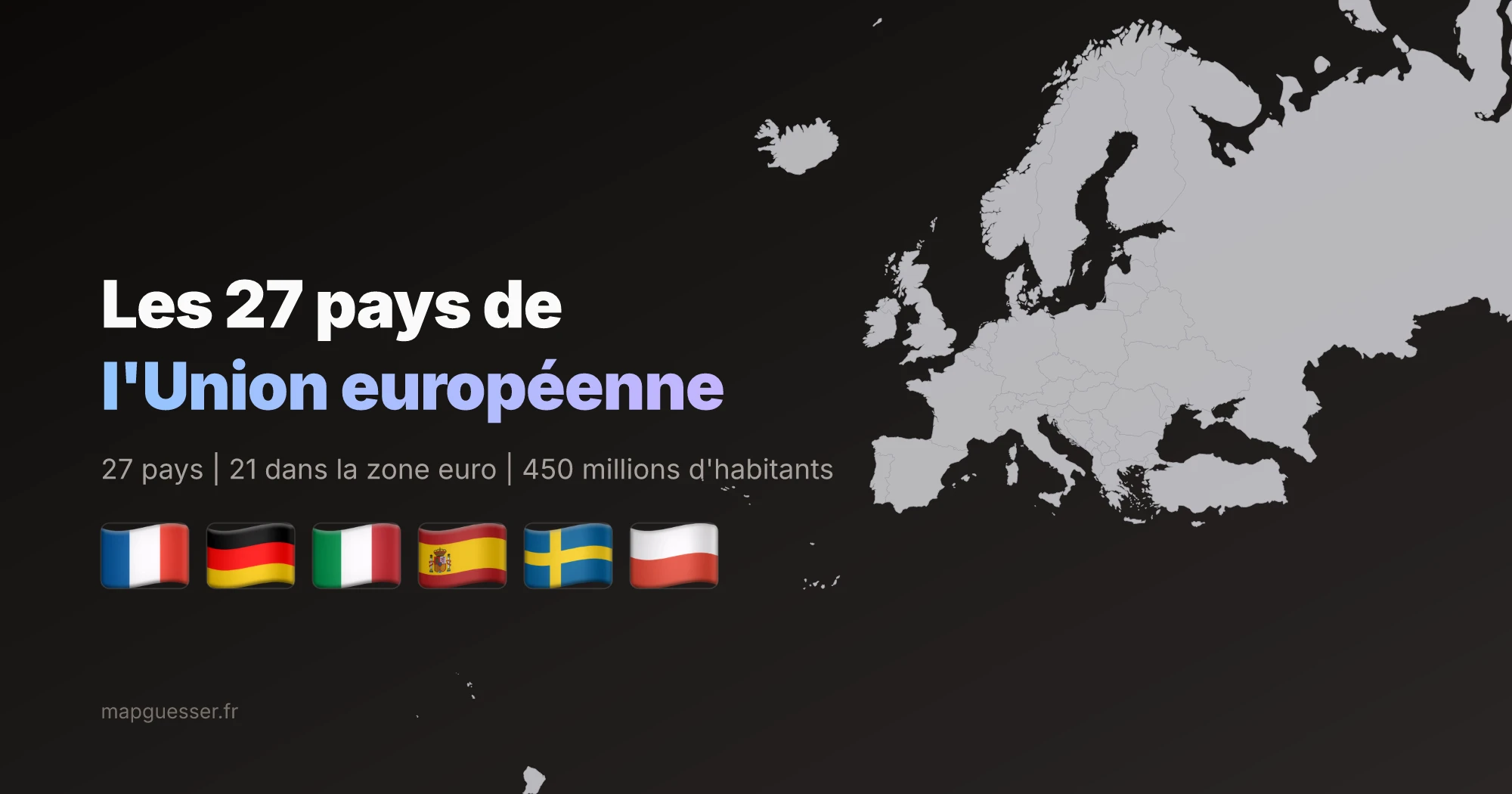
Out of the 45 countries covered on this page, 27 belong to the European Union. The EU therefore does not cover all of Europe: the United Kingdom, Norway, Switzerland, Serbia, Ukraine, Moldova and Turkey are all European countries without being members of the Union.
The 27 EU member states are: Austria, Belgium, Bulgaria, Croatia, Cyprus, Czechia, Denmark, Estonia, Finland, France, Germany, Greece, Hungary, Ireland, Italy, Latvia, Lithuania, Luxembourg, Malta, Netherlands, Poland, Portugal, Romania, Slovakia, Slovenia, Spain and Sweden.
What are the European microstates?
Europe is home to several famous microstates. Andorra, Liechtenstein, Monaco and San Marino are included in this list of 45 UN-recognized states. Vatican City is often grouped with them, but it is treated separately here because it is not a member of the United Nations. Despite their tiny size, these states have outsized cultural and diplomatic visibility.
What are Europe's geographic records?
Europe is a continent of contrasts. Here are the most notable records:
- Largest country: Russia (17,098,246 km2 total), the world's largest country, straddling Europe and Asia
- Smallest country in this list: Monaco (2 km2), ahead of Liechtenstein and San Marino
- Sovereign European state outside the UN count: Vatican City (0.49 km2), often cited as the smallest state on the continent
- Most populated country: Russia (146 million), followed by Germany (84 million)
- Least populated country in this list: Monaco (38,423 inhabitants)
- Highest mountain: Mount Elbrus in Russia (5,642 m), in the Caucasus
- Longest river: the Volga (3,530 km), entirely in Russia
- Largest lake: Lake Ladoga in Russia (17,700 km2)
- Smallest area (excluding microstates): Cyprus (9,251 km2)
How can you learn European countries?
Think you know all the European countries? Challenge yourself with our interactive quizzes:
- Listing Mode: can you name all 45 European countries on a map? It's the ultimate challenge for geography enthusiasts.
- Flag Quiz Mode: can you recognize European flags? Test your visual memory with our flag quiz.
- MapGuessing Mode: place European countries on the map as precisely as possible. Every kilometer counts!
Whether you're a student, traveler, or simply curious, these quizzes are the best way to learn European geography while having fun.
Written by
Creator of MapGuesser, passionate about geography and web development.
Sources
Frequently asked questions
Europe has 45 sovereign countries recognized by the United Nations if you include Russia and Turkey, which are transcontinental. 27 of them are members of the European Union. Vatican City is also a sovereign European state, but because it is not a UN member it is not included in this count of 45.
Russia is the largest country in Europe (and in the world) with a total area of 17,098,246 km2. Considering only the European part, Ukraine (603,550 km2) and France (543,908 km2) are the largest countries entirely in Europe.
Russia is the most populated with 146 million inhabitants. Counting only fully European countries, Germany leads with 84 million, followed by the United Kingdom (69 million) and France (66 million).
Within the scope of this list of 45 UN-recognized sovereign states, Monaco is the smallest country in Europe at 2 km2 and around 38,000 inhabitants. If you also include Vatican City, a permanent observer state at the UN, the record drops to 0.49 km2.
27 European countries are members of the European Union, including France, Germany, Italy, Spain, Poland and the Netherlands. Countries such as the United Kingdom, Switzerland, Norway, Serbia, Ukraine and Turkey are European without being part of the EU.
The best way is to practice with interactive quizzes. On MapGuesser, the Listing mode challenges you to name all 45 countries on a map, the Flag Quiz tests your knowledge of flags, and MapGuessing mode has you place countries as precisely as possible.