The countries nobody can place on a map
When the Dominican Republic lights up on the map, 16% of players type "Cuba". When Cuba lights up, only 1% answer "Dominican Republic". People are not confusing two countries — they only know one.
In short — When the Dominican Republic lights up on the map, 16% of players type "Cuba". When Cuba lights up, only 1% answer "Dominican Republic". Thirteen times more in one direction: people are not confusing two countries, they only know one of them.
On MapGuesser, a country lights up on the map and you type its name. No list, no multiple choice. Every mistake therefore leaves something usable behind: not just that the player got it wrong, but what they put in its place. Across 316,566 rounds, here is what that draws.
What people type instead
Out of 592,000 answers, roughly 247,000 are wrong once skips are removed. (A round allows several attempts, which is why the share of wrong answers exceeds the share of failed rounds.)
The find is not which pairs come up — Iraq for Iran, Benin for Togo, none of that surprises. It is whether they run both ways. For that, each error has to be measured against how often the country appeared:
| When this country lights up… | …this name gets typed | Rate |
|---|---|---|
| Honduras | Nicaragua | 17.0% |
| Nicaragua | Honduras | 18.4% |
| Dominican Republic | Cuba | 16.2% |
| Cuba | Dominican Republic | 1.2% |
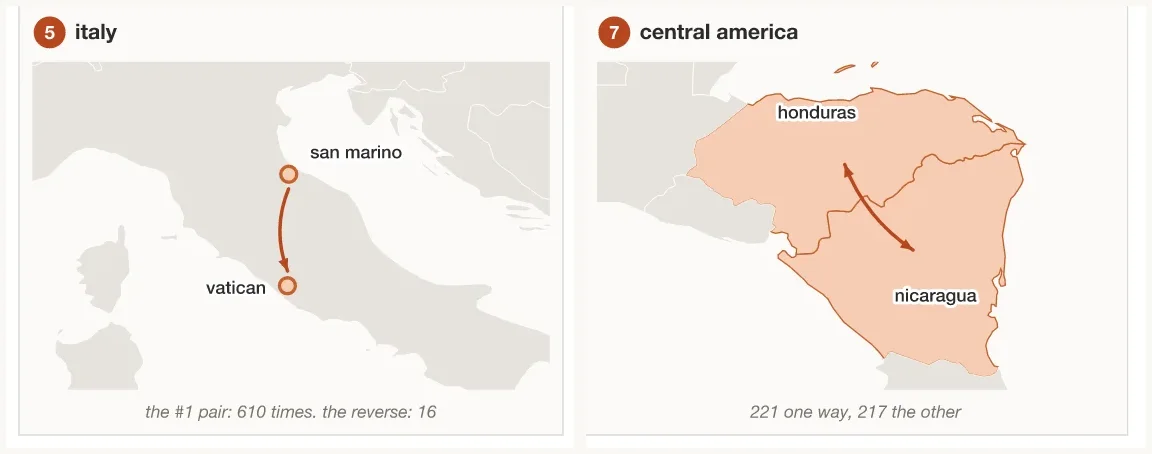
Honduras and Nicaragua swap at 17% against 18.4%. Perfectly reversible: people know there are two countries there, they just cannot tell which is which.
The Dominican Republic and Cuba are 16.2% against 1.2% — thirteen times more in one direction. This is no longer hesitation between two labels: Cuba is the only name available for the whole area, and it swallows its neighbours. The most striking case is San Marino: 31.7% of its appearances draw a "Vatican". The reverse happened only 16 times — but the Vatican comes up so rarely that it misses our 200-round threshold, so treat that last figure as an indication, not a measurement. It is not a mix-up, it is a gap in vocabulary.
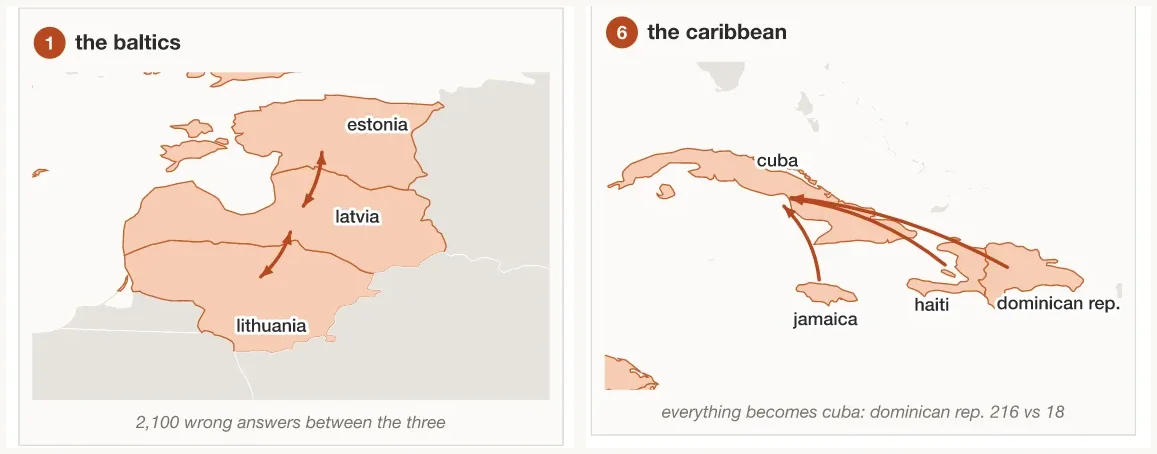
The Baltic states are the symmetric case par excellence: 2,100 errors between the three, both ways for every pair.
Two ways to be wrong — and one way to have nothing
- Hesitating between two neighbours. The knowledge is there, the label is on the wrong one. Baltics, Honduras/Nicaragua.
- Knowing only one name for a whole area. San Marino becomes the Vatican, the Antilles become Cuba.
Both assume the player attempts something. But an absorbing name already assumes you know a name for the area. That leaves the case where there is none — the gap is no longer partial but total, and it produces no confusion at all: nothing whatsoever.
The extreme case: countries nobody has a name for
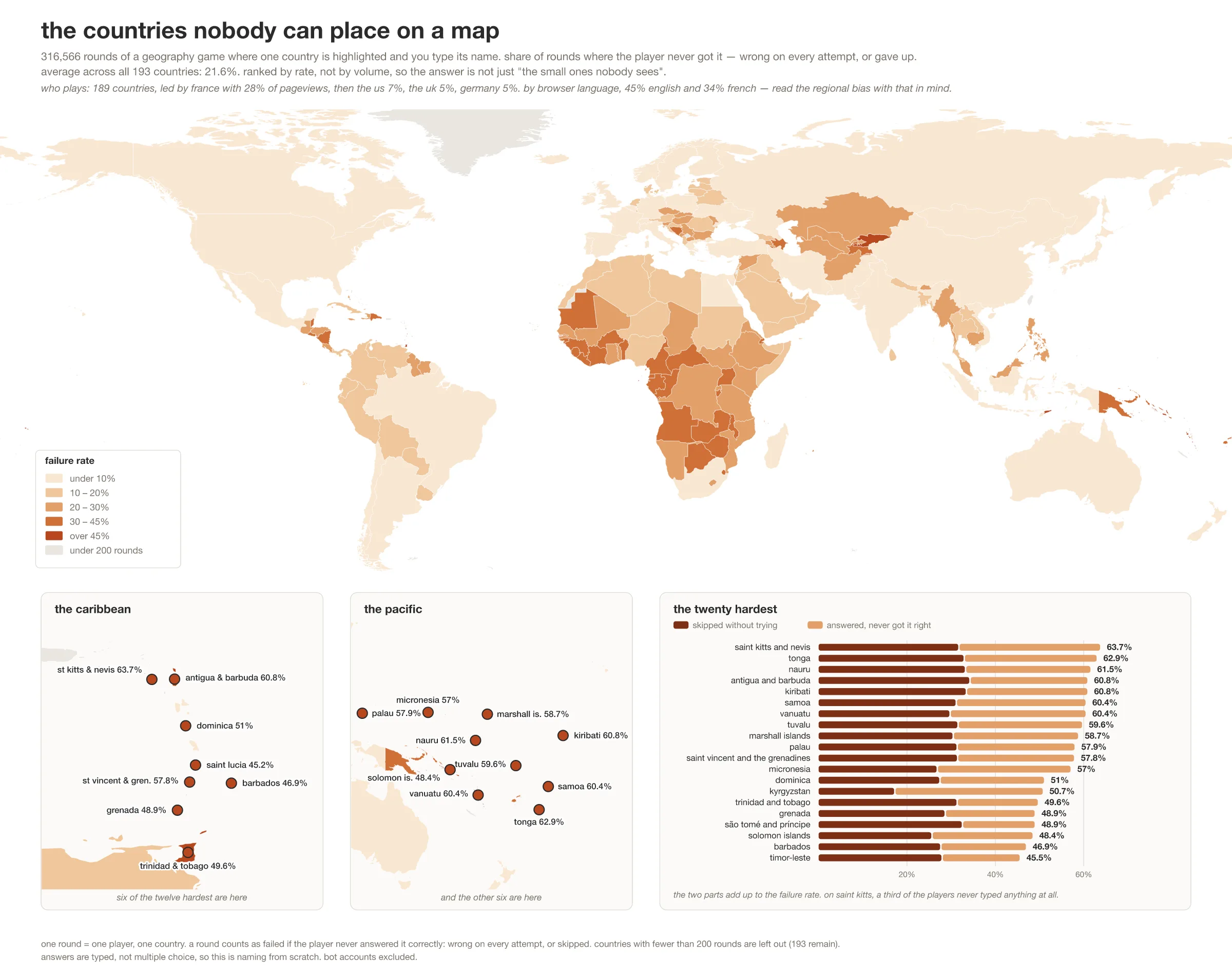
A round counts as failed if the player never gets it: wrong on every attempt, or gave up. Across all rounds: 21.6%.
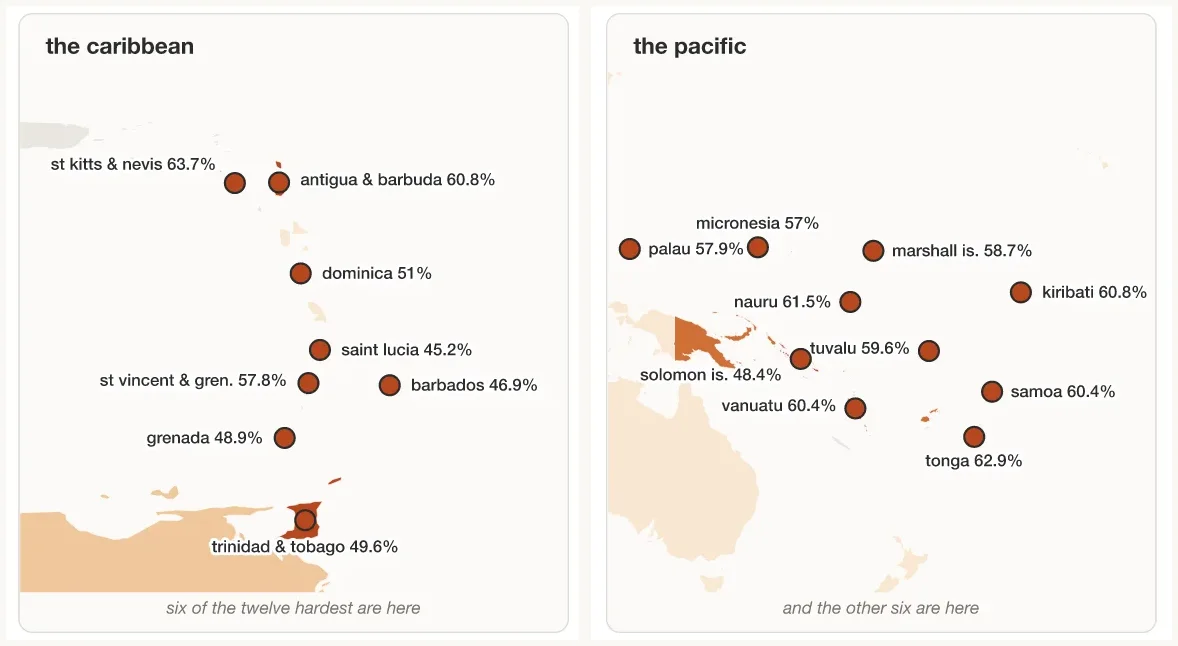
Here are the twelve worst, all above 57%, each on roughly a thousand rounds:
| Country | Failure | |
|---|---|---|
| 1 | Saint Kitts and Nevis | 63.7% |
| 2 | Tonga | 62.9% |
| 3 | Nauru | 61.5% |
| 4 | Antigua and Barbuda | 60.8% |
| 5 | Kiribati | 60.8% |
| 6 | Samoa | 60.4% |
| 7 | Vanuatu | 60.4% |
| 8 | Tuvalu | 59.6% |
| 9 | Marshall Islands | 58.7% |
| 10 | Palau | 57.9% |
| 11 | Saint Vincent and the Grenadines | 57.8% |
| 12 | Micronesia | 57.0% |
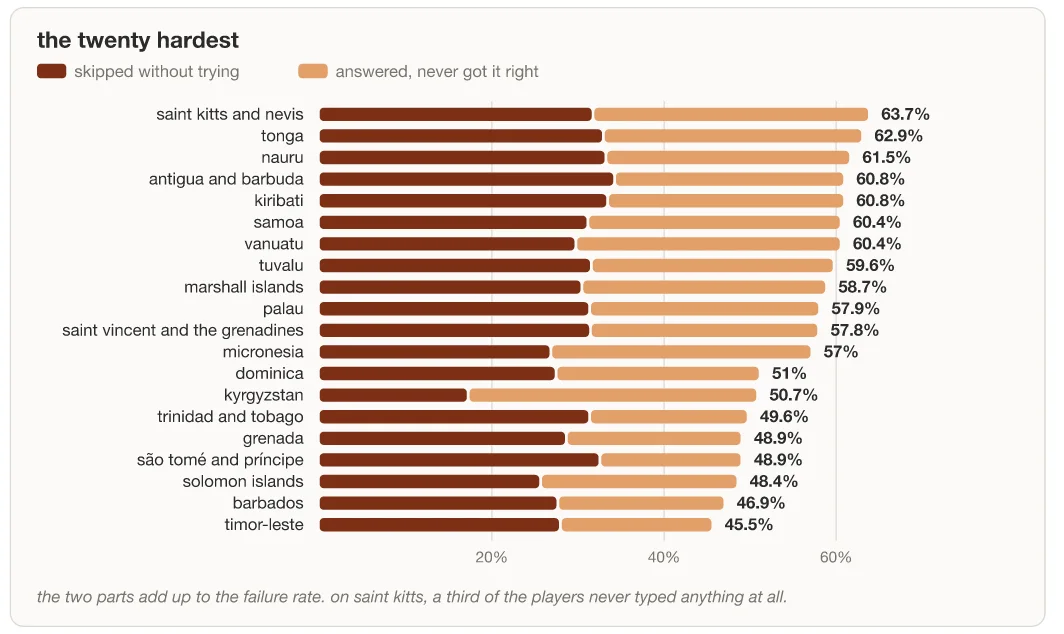
Twelve island microstates: three in the Caribbean, nine in the Pacific. Not a single mainland country before thirteenth place.
It is not only isolation
First instinct: count the borders. The 39 countries with no land neighbour sit at 37.6% median failure, against 17 to 21% for the rest. Clear-cut — except those 39 are almost all tiny islands. Size and isolation move together, so the table separates nothing.
One variable has to be held still to test the other. Threshold used: 50,000 km², roughly Slovakia.
| Group | Countries | Median failure |
|---|---|---|
| Large, no neighbour | 8 | 8.2% |
| Large, with neighbours | 118 | 18.4% |
| Small, with neighbours | 36 | 24.3% |
| Small, no neighbour | 31 | 48.9% |
Neither variable is enough on its own. A small country surrounded by neighbours stays at 24.3%; a large country with none drops to 8.2% — Japan and Australia are islands, and nobody misses them. It is the combination that kills.
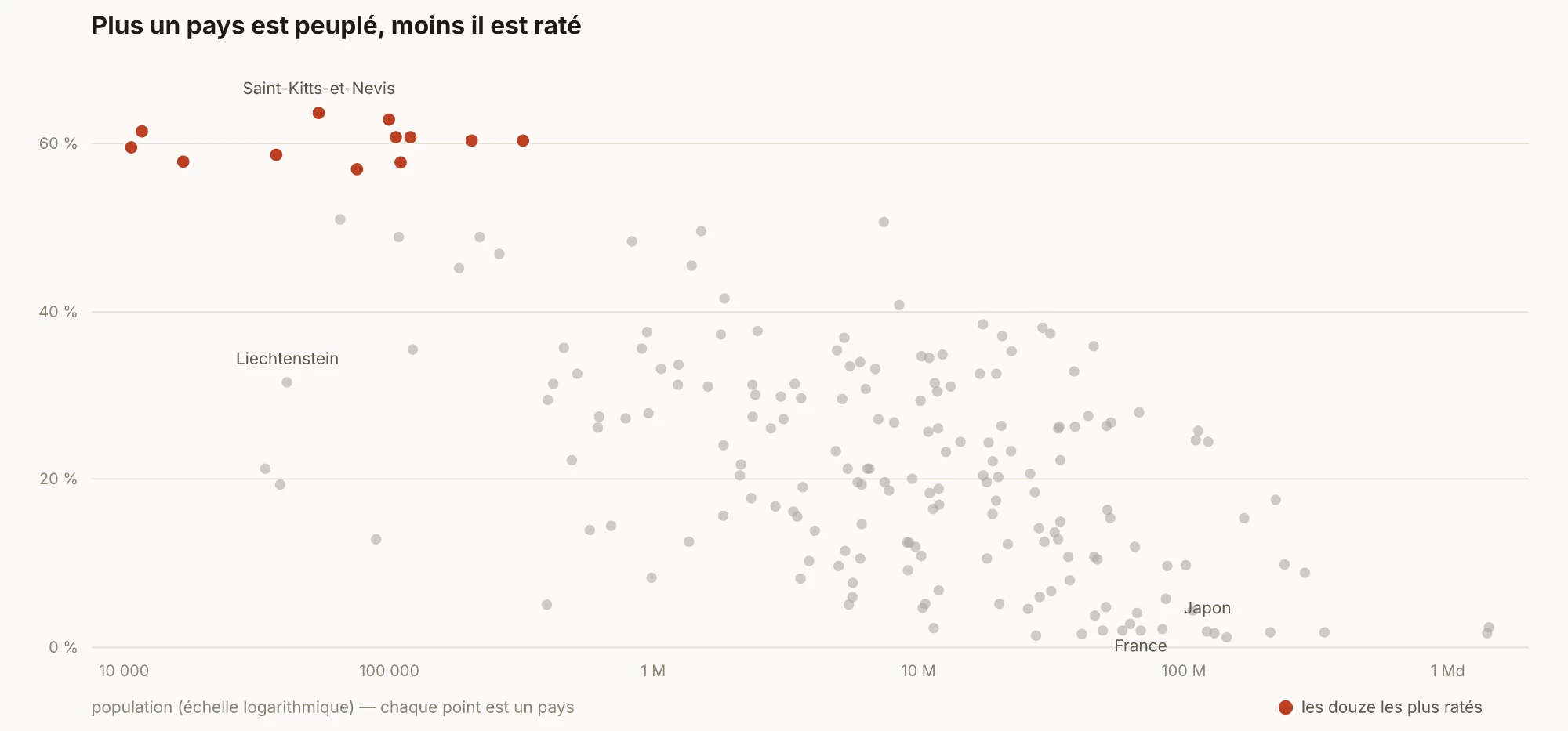
Across the 193 countries, rank correlation leans the same way: −0.57 with population, −0.41 with borders. The player loses first because he never hears about the country; isolation then removes his last resort, guessing by elimination.
(The "large, no neighbour" cell holds only 8 countries: an indication, not a measurement.)
The ones who never even try
That is the dark red bar in the chart. Measured against all rounds, 4.9% end without a single keystroke — the player sees the country light up and moves on at once. On Nauru or Antigua, it is one round in three. A factor of seven.
Skipping costs points, so it is not free. That said, you cannot read a state of mind off a trace: end of session, time-versus-score trade-off and an abandoned tab all produce the same signal. What is certain is that no name came.
The bug the comments uncovered
A player told us the game was rejecting correct answers. He was right: 628 valid spellings refused, amounting to 13,561 answers. A matching threshold set too strictly. A fix is underway.
That caps out at 4.3 points of the 21.6%, and only if each one had single-handedly failed its round. The twelve-country ranking is no artefact: they account for 0.7% of the rejections. The bug hits "lichtenstein", "philipines", "kazakstan" — you can only misspell what you attempt.
Method
316,566 rounds of the Mapguessing mode, with data through 25 August 2026. Bots excluded, countries under 200 rounds excluded — 193 remain, which leaves out the Vatican. Borders, areas and populations come from the site's own country data.
Three caveats, in order of importance:
- You type the name, you do not pick it. That is recall, not recognition: a multiple choice would have produced far kinder scores.
- On a world map, a country of 21 km² occupies a few pixels. Some of these failures may come down to legibility as much as knowledge; we cannot separate the two here.
- These players opened a geography game on purpose. 21.6% is a floor, not a measure of the general population.
Your turn
One question we have not settled: does a French player miss the same countries as an American one? We have the data and we are digging — that will be the next article.
Meanwhile, Mapguessing will tell you very quickly whether Kiribati rings a bell.
Written by
Creator of MapGuesser, geography and web development enthusiast.
Sources
Frequently asked questions
On MapGuesser it is Saint Kitts and Nevis, missed in 63.7% of rounds, ahead of Tonga (62.9%), Nauru (61.5%), Antigua and Barbuda (60.8%) and Kiribati (60.8%). The twelve hardest are all island microstates, overwhelmingly in the Pacific. For comparison, the average failure rate across all countries is 21.6%.
The three Baltic states between themselves (Estonia, Latvia, Lithuania) account for 2,100 wrong answers, the record. Then come Iraq typed for Iran (449 times), the Central Asian countries among themselves (2,527 errors), Honduras and Nicaragua swapped both ways, Czechia taken for Austria, Guyana and Suriname, and every Caribbean island becoming Cuba.
It is not just about size on screen. An island microstate has no land neighbour to serve as a clue, it rarely makes the news, and its name is unfamiliar. The player has nothing to grab onto — whereas an obscure landlocked country can still be worked out by elimination thanks to its neighbours.
The UN has 193 member states, plus two observer states (the Vatican and Palestine). MapGuesser covers 254 countries and territories, but this analysis only keeps those with at least 200 rounds, which leaves 193.
Every MapGuesser round records the country shown, what the player typed and whether they got it. The analysis covers 316,566 rounds of the Mapguessing mode, with data through 25 August 2026. Bot accounts are excluded, and only countries with at least 200 rounds are kept.
Considerably. On MapGuesser you type the name from scratch, with no options offered. That is recall, not recognition. A four-option multiple choice would have produced far higher success rates — worth keeping in mind before comparing these numbers to another quiz.